Eye opening and enjoyable - the inside cover of my copy says 'There are books which let us into the hidden parts of life and make them vividly real' and this is certainly one of them. It is narrated by, and is about Matthew, whose older brother Simon died when he (Matt) was 9. Matt tells us of what follows, of his mum and dad trying to cope and the way in which Matt himself isn't coping. It is compelling - there are unanswered questions throughout and we are slowly allowed to fill in the gaps.
The Shock of the Fall is about mental illness and the different forms it can take. The author does a really good job of letting us know, without exactly telling us, what kind of person Matt is. You recognise him and it is like siting on the other side of the fence. It feels very contemporary and it feels very real.
Next up is one from the other end of the spectrum A Room with a View, by E.M Forster
Tuesday, 19 November 2013
Sunday, 10 November 2013
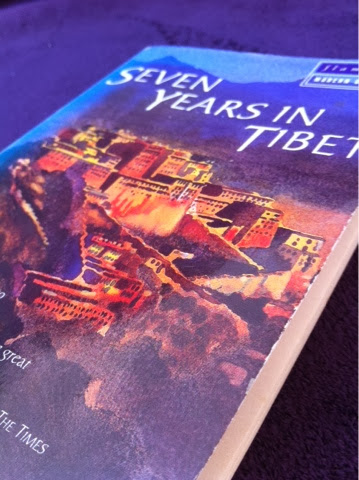
Seven Years In Tibet, Heinrich Harrer
This is a brilliant book - it is an adventure story, travel book, and memoir. Heinrich Harrer was an Austrian mountaneer, ski champion and one of the four who first climbed the North Face of the Eiger. Harrer was climing in the Himalayas when the Second World War broke out and became a prisoner of war in India.
Seven Years in Tibet describes Harrer's escape from the POW camp, his journey into Tibet with Peter Aufschnaiter and their arrival and eventual acceptance in Lhasa. It is written very matter of factly, in the beginning Harrer states 'As I have no experience as an author I shall content myself with the unadorned facts.' He proves himself an excellent narrator, not romanticising or draging out any of his experiences. It is a pleasure to be in his company.
Whilst somewhat sceptical of the superstition of the Tibetans he is a curious and interested observer. It is clear Harrer has a great love for Tibet and its people. Forced to leave on the invasion of Tibet by China he writes:
'I follow all that happens in Tibet with the deepest interest, for part of my being is indissolubly linked with that dear country. Wherever I live, I shall feel homesick for Tibet.... My heartfelt wish is that this book may create some understandng for a people whose will to live in peace and freedom has won so little sympathy from an indifferent world'
A beautiful and intriguing book well worth a read. Next is 'The Shock of the Fall' by Nathan Filer.
Seven Years in Tibet describes Harrer's escape from the POW camp, his journey into Tibet with Peter Aufschnaiter and their arrival and eventual acceptance in Lhasa. It is written very matter of factly, in the beginning Harrer states 'As I have no experience as an author I shall content myself with the unadorned facts.' He proves himself an excellent narrator, not romanticising or draging out any of his experiences. It is a pleasure to be in his company.
Whilst somewhat sceptical of the superstition of the Tibetans he is a curious and interested observer. It is clear Harrer has a great love for Tibet and its people. Forced to leave on the invasion of Tibet by China he writes:
'I follow all that happens in Tibet with the deepest interest, for part of my being is indissolubly linked with that dear country. Wherever I live, I shall feel homesick for Tibet.... My heartfelt wish is that this book may create some understandng for a people whose will to live in peace and freedom has won so little sympathy from an indifferent world'
A beautiful and intriguing book well worth a read. Next is 'The Shock of the Fall' by Nathan Filer.
Monday, 14 October 2013
The Yellow Birds, Kevin Powers
The Yellow Birds doesn't feel like something I can critique, it is emotive and beautifully written but feels too real and too possible.
Kevin Powers is a poet and served in the US army in Iraq in 2004 and 2005. When the novel came out and I was still working at Waterstones, I remember reading that he had set out to write something which conveys the feeling of war. It ends on hope and is certainly worth reading.
Thank you Sceptre for the proof. I think Seven Years in Tibet, by Heinrich Harrer is next.
Wednesday, 9 October 2013
Amity and Sorrow, Peggy Riley
Amity and Sorrow tells us of a woman and her two daughters who are running away from their family and everything the daughters have ever known. The 'family' is one man and 50 wives (the woman was the first) who have gradually, over the years turned into a cult. It is broadly about surviving, ideas of how best to live and how adaptable different people can be.
Amity is the youngest daughter, and the character I most liked, it is understandable the way she tries to reconcile her beliefs from he life before with what she sees and feels to be right in life outside. She is contrasted with her sister, Sorrow, who is indoctrinated to the point of insanity. Though again this is understandable - she has been pulled from the world she has known into one completely different which seems harsh, unloving and evil.
There is a really interesting point of view from the mother. Through her memories we piece together the beginning of the cult, how it evolved, all the comfort and safety it gave for years.
Amity and Sorrow is a compelling and rich read, the author is considered and doesn't take an opportunity to slate religion or fundamentalism, but rather tries to point out how people can be immersed in something which isn't as safe as it seems, just because they want to find a home and family. Riley also shows that those who appear vulnerable aren't always, and can be capable of brave and terrifying action. She asks questions of cause and effect, nature and nurture. In all entertaning and questioning. Thanks for the proof Tinder Press!
Now reading The Yellow Birds by Kevin Powers.
Amity is the youngest daughter, and the character I most liked, it is understandable the way she tries to reconcile her beliefs from he life before with what she sees and feels to be right in life outside. She is contrasted with her sister, Sorrow, who is indoctrinated to the point of insanity. Though again this is understandable - she has been pulled from the world she has known into one completely different which seems harsh, unloving and evil.
Amity and Sorrow is a compelling and rich read, the author is considered and doesn't take an opportunity to slate religion or fundamentalism, but rather tries to point out how people can be immersed in something which isn't as safe as it seems, just because they want to find a home and family. Riley also shows that those who appear vulnerable aren't always, and can be capable of brave and terrifying action. She asks questions of cause and effect, nature and nurture. In all entertaning and questioning. Thanks for the proof Tinder Press!
Now reading The Yellow Birds by Kevin Powers.
Sunday, 15 September 2013
The Customs of the Kingdoms of India, Marco Polo
I don't have a great deal to say about this one. It is very dated which makes it interesting and some of it is obviously made up and/or exaggerated. The tone is notable, it is a little like listening to an old man you have just met, quite formal but immediate and it feels like a dialogue rather than a piece of writing.
He is pre-occupied with describing the trade and flora/fauna of the countries he is telling of, so sometimes it reads a little like a catalogue! All the rulers seem to be 'one of the richest rulers in the world'. Worth a read though.
Can't decide on the next book, possibly The Infatuations by Javier Marias.
Extremely Loud and Incredibly Close, Jonathan Safran Foer
This was a brilliantly original book. It uses images and the layout of the pages to help tell the story.
The main plot follows nine-year-old Oskar. Oskar is greiving for his dad, who died in 9/11 (which at this point is around a year ago). He finds a key in his dad's wardrobe and tries to find its lock. It is a book full of difficult lives, but it feels honest and isn't depressing, more humbling. Safran Foer entwines the stories of Oskar's grandparents with that of Oskar, and you also get glimpses of other lives though the people Oskar meets trying to find the lock.
Oskar is incredibly engaging. He is insatiably curious and invents things when he is nervous or can't sleep.
Also I designed a pretty fascinating bracelet, where you put a rubber band around your favourite book of poems for a year, and then you take it off and wear it.
The way it is written feels very real and honest, partly because sometime it feels a little disjointed and less coherent than you might expect. This adds to the feeling of the reality of the lives Safran Foer is describing. Though it also means that on finishing the book, I felt i wanted to turn over and start again from the beginning, to get all the things I may have missed. This feeling wasn't helped by the fact I devoured the last 10 pages or so. It is definitely one I want to read again.
I invented a book that listed every word in every language. it wouldn't be a very useful book, but you could hold it and know that everything you could possibly say was in your hands.
Marco Polo is telling me about India now, not sure how truthful he is being.
The main plot follows nine-year-old Oskar. Oskar is greiving for his dad, who died in 9/11 (which at this point is around a year ago). He finds a key in his dad's wardrobe and tries to find its lock. It is a book full of difficult lives, but it feels honest and isn't depressing, more humbling. Safran Foer entwines the stories of Oskar's grandparents with that of Oskar, and you also get glimpses of other lives though the people Oskar meets trying to find the lock.
Oskar is incredibly engaging. He is insatiably curious and invents things when he is nervous or can't sleep.
Also I designed a pretty fascinating bracelet, where you put a rubber band around your favourite book of poems for a year, and then you take it off and wear it.
The way it is written feels very real and honest, partly because sometime it feels a little disjointed and less coherent than you might expect. This adds to the feeling of the reality of the lives Safran Foer is describing. Though it also means that on finishing the book, I felt i wanted to turn over and start again from the beginning, to get all the things I may have missed. This feeling wasn't helped by the fact I devoured the last 10 pages or so. It is definitely one I want to read again.
I invented a book that listed every word in every language. it wouldn't be a very useful book, but you could hold it and know that everything you could possibly say was in your hands.
Marco Polo is telling me about India now, not sure how truthful he is being.
Tuesday, 20 August 2013
Metamorphosis and Other Stories, Franz Kafka
To be perfectly honest I found this pretty annoying. The story Metamorphosis is interesting, about a man who wakes one day to find he has turned into a giant insect. Kafka explains the family's reaction and how their attitude changes to him over time. In the Penal Settlement is also alright. However each of the other three stories are irritating and dull at best. The Burrow forces you to listen to the insecurities of a burrowing animal for pages and pages - it seems to be a theme that Kafka's characters are self absorbed and neurotic.
At the
end of the book I got the feeling I got at the end of Women in Love-
that I wouldn't like or agree with the author if I met them. Which,
fairly or unfairly, means I am not inclined to spend my free time with
them or their inventions.
As it is Kafka you think there is a parallel meaning which will
be important, or even just interesting. However the way in which he
writes pushes you away and ensures you have none but a passing interest
in what that might be.
I have just started Extremely Loud and Incredibly Close by .... I'm very excited as it has been highly recommended by someone who has never recommended me a less than brilliant book!
Subscribe to:
Posts (Atom)